Designed the AI agentic flow to automate over 70M customer messages per month, ensured user clarity, trust and reliable responses from conversational AI replies
Summary
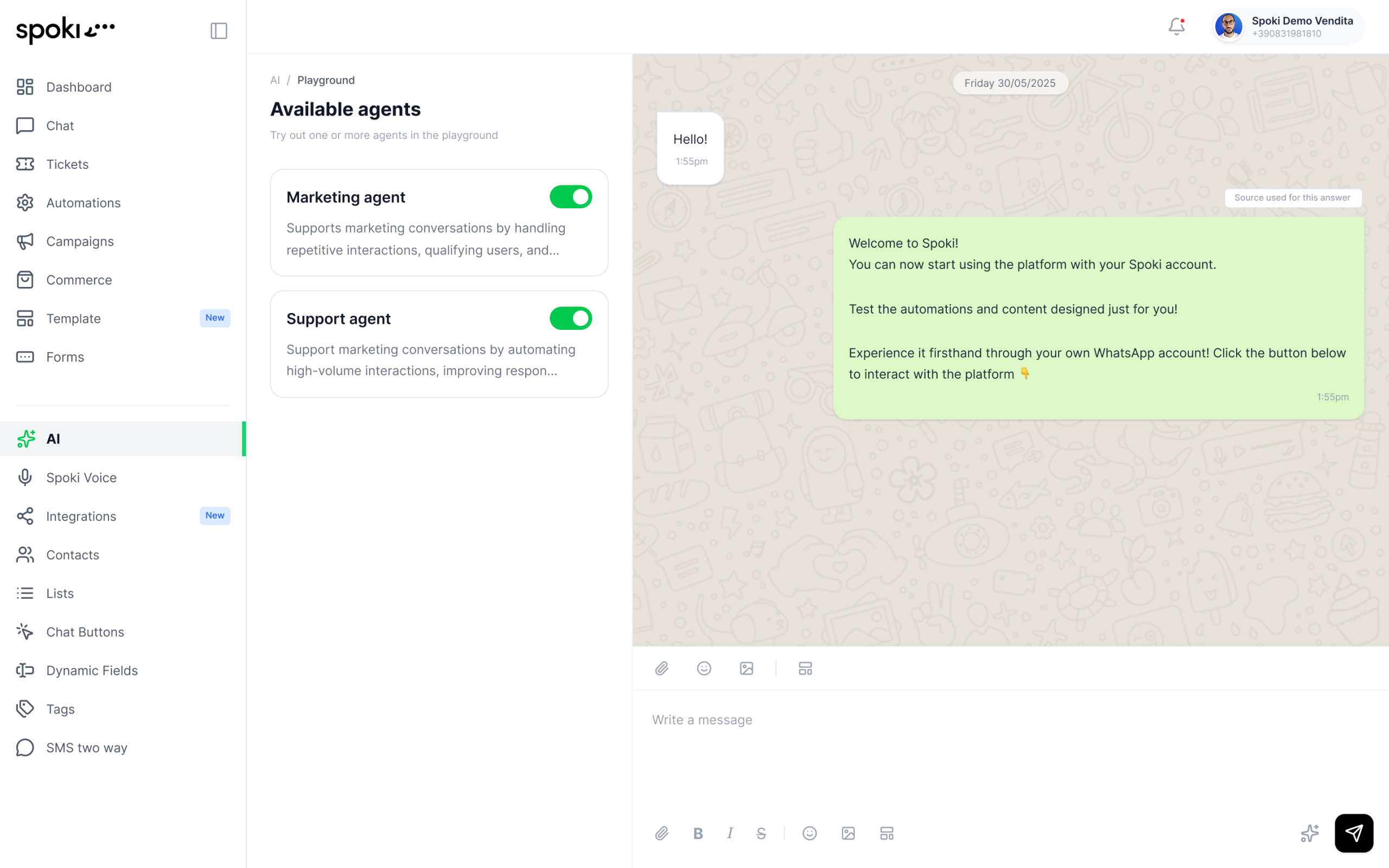
I led the design of Spoki's AI Agentic feature from the ground up — a conversational automation tool that empowered businesses to create intelligent agents capable of handling complex, multi-turn customer interactions. Through live co-design with engineering, transparent validation flows, and continuous discovery, we shipped a feature that achieved 70% activation within the first week and became a key revenue driver for higher-tier plan upgrades.
Focus: Trust, transparency, and actionable automation
Role & Scope
Title: Founding Product Designer, AI
I led design across research, prototyping, interaction design, and post-launch measurement, partnering closely with product, engineering, and data science teams to define a trustworthy, scalable AI experience that balanced user control with intelligent automation.
Design Challenge
Design an AI agent creation system that's transparent, predictable, and adaptable across user types — turning complex backend validation into a reassuring, forward-progress experience that builds confidence in automated conversations.
Context
At Spoki, our support and sales teams were hearing constant requests from power users about wanting to automate more complex conversation flows. They wanted something smarter that could handle natural language and adapt to different customer inputs — not just scripted responses.
We also saw competitors starting to ship AI-powered features, and we were getting questions from prospects like "Do you have AI agents?" There was clear market pressure to deliver on this capability.
But businesses were excited about the potential while also nervous about losing control or the AI saying something wrong. Our challenge was to design a tool that empowered users to automate entire conversations while maintaining transparency, control, and trust.
Key Responsibilities
- Established live co-design process with engineering to accelerate delivery and reduce handoff friction
- Designed transparent validation flows with multi-step progress indicators to manage user anxiety during processing delays
- Defined UX patterns for agent configuration, testing, and error recovery
- Tracked activation metrics and feature adoption post-launch to validate impact and inform iteration
Problem Details
The Business Opportunity
Spoki's core value was enabling businesses to automate WhatsApp conversations at scale. But existing automation was limited to basic, scripted flows. Users wanted intelligent agents capable of understanding natural language, handling conditional logic, and integrating with external data sources.
The Impact of Not Shipping:
- Losing competitive differentiation as competitors launched AI features
- Missing revenue opportunities from power users willing to upgrade for advanced automation
- Risking churn from users who needed more sophisticated conversation capabilities
The Technical Challenge
Building AI agents introduced backend complexity that impacted the user experience. When users finished creating a new agent and hit "Save," the backend had to run several validation tests to ensure everything was configured correctly without conflicts.
This process took anywhere from 10 to 30 seconds.
The variability came from the complexity of what users were configuring:
- Simple agents (basic welcome message, couple of responses): 10-12 seconds
- Complex agents (multiple conversation branches, conditional logic, external integrations): 25-30 seconds
From a UX perspective, this was a critical problem. If users were waiting without visibility into what was happening, they could get impatient and drop out of the flow. Feature adoption could fail — not because the feature wasn't useful, but because the experience felt slow and frustrating.
Why It Mattered
For Spoki's power users, AI agents represented a fundamental shift in how they could serve customers. The ability to connect integrations, define agent behaviors and knowledge, and automate entire conversations was transformative.
But if the creation experience felt unreliable or opaque, users wouldn't trust the feature. And without trust, adoption would stall.
By designing for transparency and perceived progress, we could:
- Build confidence in the AI system through observable validation steps
- Reduce abandonment during the agent creation flow
- Differentiate Spoki as a platform with thoughtful, user-controlled AI
- Drive revenue through upgrades to higher-tier plans for advanced AI capabilities
Opportunity
Deliver an AI agent creation experience that:
- Automates complex conversations while maintaining user control
- Provides transparent validation and error handling
- Reduces anxiety during backend processing delays
- Scales to diverse use cases, from simple welcome messages to multi-branch conditional flows
The goal was to transform AI automation from a black box into a predictable, transparent experience built around explainability and usability.
Goals
- Activate users who create agents (percentage who connect agents to live conversation flows)
- Reduce drop-off during agent creation validation
- Drive feature adoption among power users
- Position AI agents as a revenue driver for higher-tier plan upgrades
- Establish scalable patterns for future AI feature development
- Build user trust in Spoki's AI capabilities
Collaboration & team
From the very beginning, I worked hand-in-hand with the product trio (PM, engineering, data science). We kicked things off by aligning on how this could actually work in practice.
I believe when viability, usability, and feasibility work together, everyone stays on the same page and decisions are higher in quality.
We could have spent weeks just writing requirements for the "perfect" feature and still never shipped anything. So we shifted to a live co-design approach to move faster.
In practice:
- I was prototyping directly in Figma and sketching flows
- Engineers flagged constraints and trade-offs in real time
- We made decisions collaboratively, balancing user needs with technical feasibility
This helped us avoid the classic handoff model that usually takes weeks of back-and-forth.
The Edge Cases: Managing Validation Delays
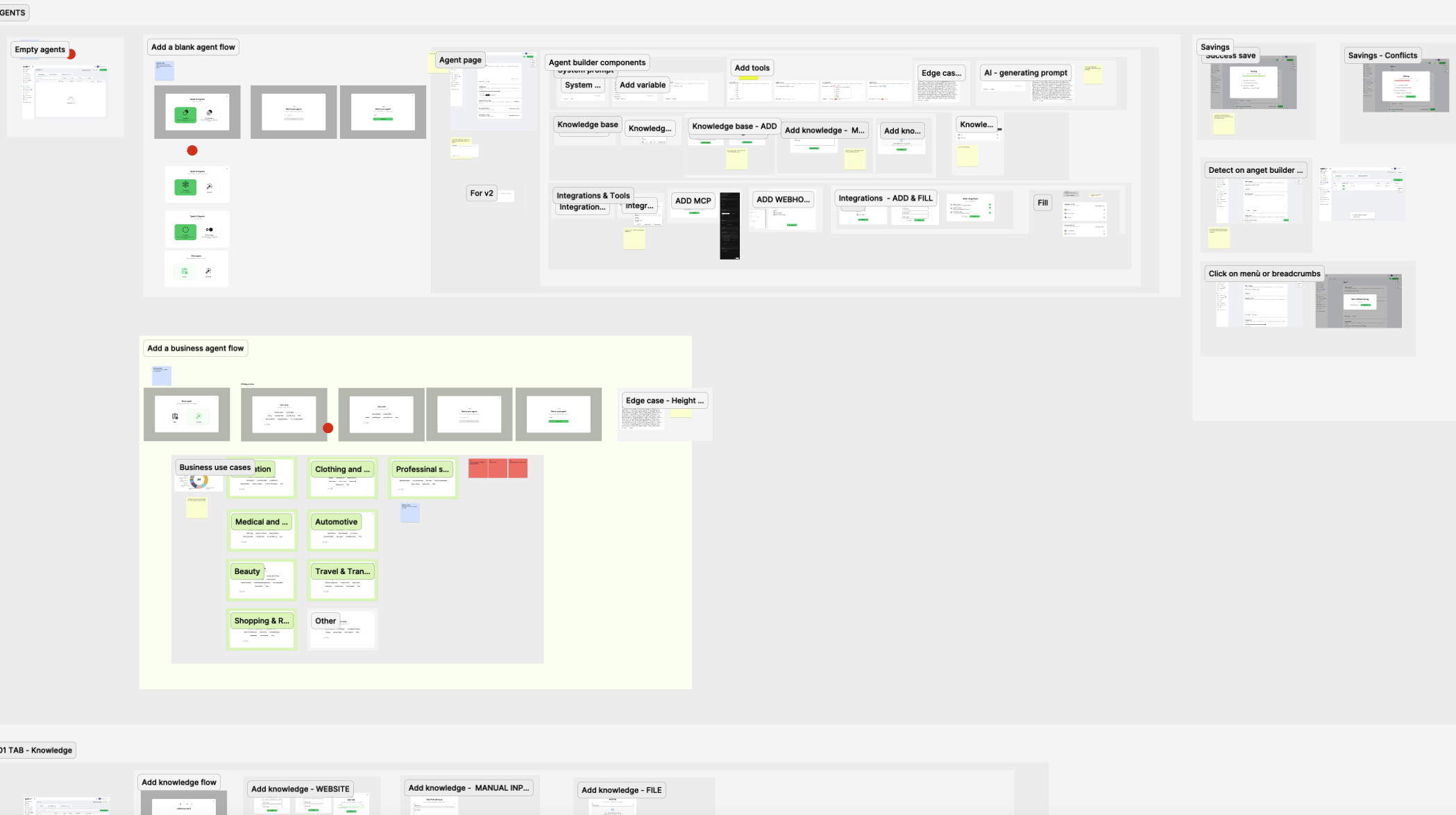
There were so many edge cases to think about to make the feature smooth and reliable.
One challenge that came up was the agent creation flow. When users finished creating a new agent and hit "Save," the backend had to run several validation tests to make sure everything was configured correctly without conflicts.
The fastest option was just to show a loading spinner. But from a UX perspective, I knew this was a big problem. My assumption was that if users were waiting without visibility, they could get impatient and drop out of the flow.
If that happened, feature adoption would fail — not because it wasn't useful, but because the experience felt slow and frustrating.
Design & Validation
I proposed a few different alternatives to make sure that wait felt productive instead of just frustrating.
Solutions Identified:
- Asynchronous Validation Run validation checks in the background and send notifications when complete. But this would've meant users had to come back to the flow later, which would've broken momentum.
- Multi-Step Progress Indicator (Chosen Solution) Design a transparent validation experience that showed exactly what was happening at each stage. Users could see forward progress instead of staring at a loading spinner wondering what's going on.
Each step would show as complete once the backend confirmed it passed.
For edge cases where validation failed, we showed a clear error message on the page so users knew exactly what to fix.
The validation still took the same amount of time on the backend, but the experience felt way smoother and more reassuring.
Solution
Outcome
Agent Activation:
- 70% of users who created an agent activated it and connected it to a live conversation flow within the first week
- Strong signal that people weren't just experimenting — they had real use cases in mind
Revenue Impact:
- AI agents became a differentiator in sales conversations
- Drove upgrades to higher-tier plans, especially for businesses wanting advanced AI capabilities or higher message volumes
Broader Impact:
- Validated investment in building AI thoughtfully, not just shipping because it's trendy
- Established scalable patterns for transparency and trust in future AI features
- Positioned Spoki as a platform with user-controlled, reliable AI automation
Reflection
Designing AI features requires balancing automation with control. Trust comes from transparency — not just capability.
By making validation observable, giving users control over agent behavior, and designing for perceived progress during delays, we turned a complex backend process into a confidence-building experience.
The key lesson: AI doesn't need to be perfect. It needs to be predictable, transparent, and recoverable. When users can see what's happening and feel in control, they trust the system — and adoption follows.
© SIMONE PULVIRENTI 2026
I'm excited to work together!
Say hi to drsimone.pulvirenti@gmail.com
https://www.linkedin.com/in/simonepulvirenti/
